Border rules can turn a legal bladder prescription into contraband. Here is the paperwork, packing method and country checks that keep your supply safe.
Part 3 of 4 in the series Go Anywhere: The Traveller's Guide to Urological Confidence.
Once your catheter supplies or continence kit clears the security lane, the next risk is not the scanner. It is the customs desk on the other end, where a medication that is perfectly ordinary at home can suddenly be treated as a controlled substance. Nothing about the bottle changes when the plane lands.
This series was developed with insights from Dr. Matthew Karlovsky, whose work with patients managing complex bladder conditions shaped the practical approach you will find here. One theme comes up again and again: the travellers who run into trouble abroad are almost never careless. They simply assumed that a legal prescription travels as freely as they do.
A prescription is a legal permission slip issued under one country's laws. It carries no automatic weight in another. The officer in front of you is applying their own national drug schedules, their own import limits, and their own rules about what counts as a personal supply.
Three things shift the moment you cross a line on a map:
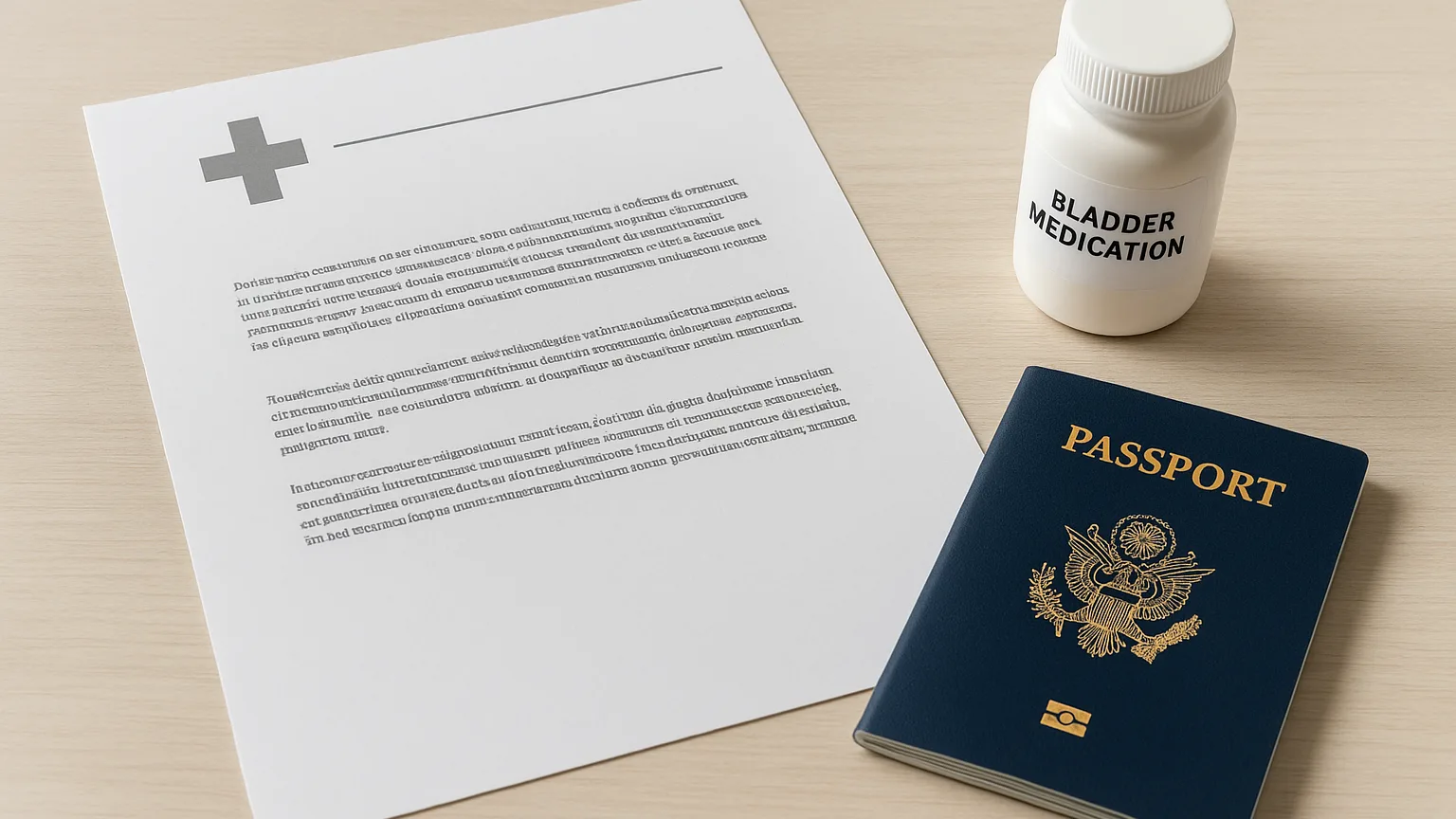
The paperwork that solves nearly all of this is small and unglamorous: a signed physician's letter on clinic letterhead, carried in your hand luggage. It turns a bag of loose pills into a documented medical necessity, and it does more work at a customs desk than any pharmacy label ever will.
Not every bladder medication is a risk. Most anticholinergics and beta-3 agonists used for overactive bladder pass without comment almost everywhere. The trouble clusters around a smaller group, and it helps to know where you sit before you pack.
Patients managing a neurogenic bladder often travel with the widest medication list, sometimes combining antispasmodics, antibiotics and injectables, which makes advance checking especially worthwhile for that group.
Do not rely on a forum post or a travel blog. Go to the destination country's own embassy website in your home country and search for "medication import" or "personal medical supplies." Most publish a page. If nothing comes up, email the embassy directly and keep the reply. A printed email from an official address has settled more than one disagreement at a customs counter.
Build in time. Japan's advance import certificate is processed by post and email and is not something you can arrange the night before departure. Dr. Matthew Karlovsky's guidance to travelling patients reflects this: start the paperwork when you book the flight, not when you pack the bag.
InterHealth works with organisations whose staff travel, relocate and deploy overseas. Preparation, support during an assignment and aftercare on return.
See our services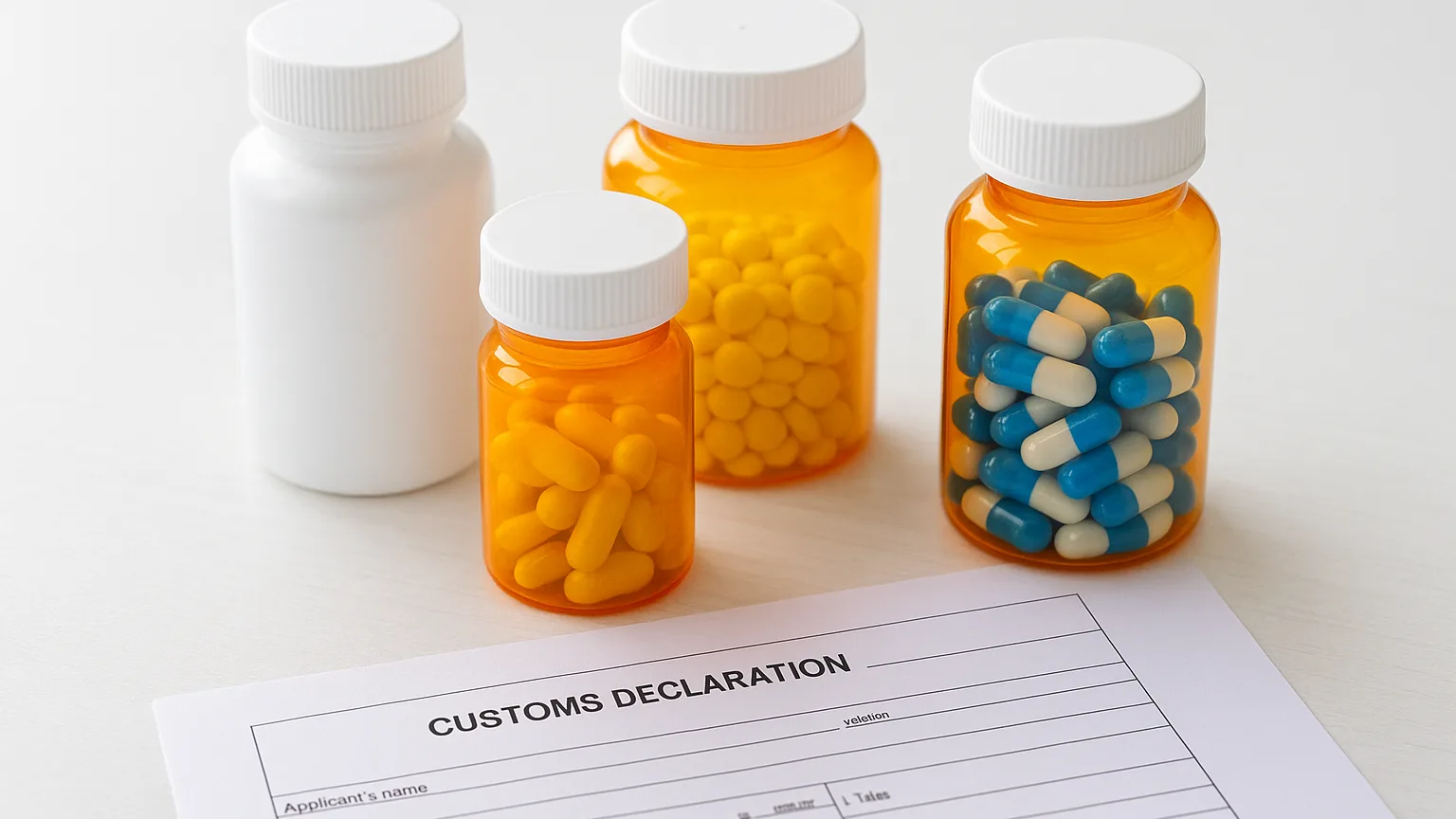
Keep everything in one clear plastic folder in your carry on, not buried in a suitcase sitting in a cargo hold while you are being questioned. Any officer, in any language, should be able to look at one page and understand who you are, what you take, and why.
Use generic names throughout. Brand names change across markets, and an officer or a foreign pharmacist may not recognise yours. The generic name is the common language of medicine worldwide.
Divide your supply: roughly two thirds in your carry on, one third in checked baggage or a companion's bag, with a copy of the letter in both. Bags go missing and hotel rooms get burgled. Splitting means a single bad event costs you inconvenience rather than your entire regimen.
Carry a few extra days beyond your planned return, but stay inside the destination's stated personal import limit. If your trip is long enough that the limit becomes a problem, plan to refill abroad instead, which is a much easier conversation when you already have a urologist lined up abroad sorted before you leave.
Declare, do not hide. If the customs form asks about medication, tick yes. Voluntary declaration with paperwork in hand takes a few extra minutes. Discovery of an undeclared controlled substance takes considerably longer and looks entirely different.
Keep refrigerated medications in an insulated pouch with gel packs rather than loose ice, and have your letter state explicitly that the item requires cold storage. Hydration habits and medication timing also shift across time zones, which connects directly to the smarter way to time your fluids approach from earlier in this series, and to the supply planning covered in flying with a catheter or stoma.
The difference between a smooth arrival and a frightening one usually comes down to a single sheet of letterhead. Border officers are not looking for reasons to make your trip difficult. They are looking for a reason to believe you, and a clear, dated, properly worded physician's letter gives them exactly that. Pair it with original labels, generic drug names, a split supply and a quick check of the destination's published rules, and the odds of losing your medication drop close to zero.
Preparation like this also buys calm. When you know your supply is documented, legal and duplicated, you start paying attention to the trip itself. And if something does go wrong medically while you are away, the same folder becomes the fastest way to explain your history to a stranger in a hospital, which is where the next part of this series picks up: finding and vetting a urologist abroad long before you actually need one.
Planning travel for staff who deploy overseas? We handle preparation, in-post support and aftercare.
Talk to InterHealthInterHealth Worldwide supports organisations whose people travel, relocate and deploy overseas, from preparation and vaccinations through to aftercare on return.

